Published: February 15, 2026
Note: This review was originally written in 2023 and is being published now with minor edits.
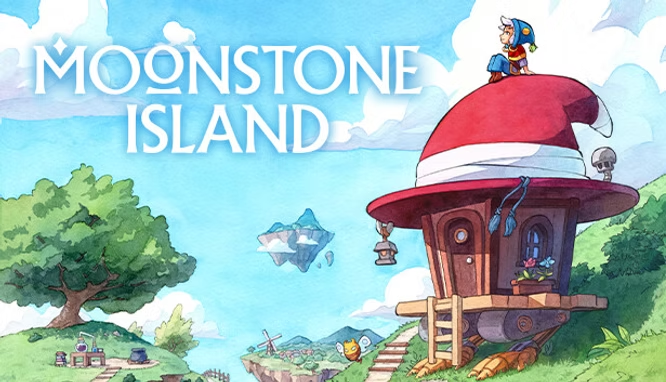
| Studio Supersoft (Developer) | Raw Fury (Publisher) Where to play: PC/Console (Steam, Switch) | Mobile (Android, iOS) |
As a connoisseur of farming sims, indie games, and cute pixel art, I immediately wishlisted Moonstone Island after stumbling upon it on the Raw Fury Facebook page. Soon after it dropped on Steam on September 20, 2023, I picked it up and was instantly hooked by the fun quests and familiar farming system, quickly locking in over 30 hours.
Moonstone Island has everything you could want in a farming sim with its own unique (and not-so-unique) spins.
Like Rune Factory and Stardew Valley, Moonstone Island is a farming simulator that incorporates RPG elements such as combat, experience points, quests, and exploration. It also has a dating system where you can romance the townsfolk and measure their interest by accumulating hearts. Similar to Ooblets, it maintains a combat system based on card and creature collection.
Where Moonstone Island differs from its farming sim predecessors is its map and method of exploration. From your homebase on Moonstone Island, a floating piece of land nestled high in the sky, you can fly to various other islands in search of dungeons and monsters.
Some islands have similar terrain to that on Moonstone island, while others are reflective of the species that live there. For example, you can recognize an electric island by its distinct fauna and constant lightning that zaps your character. Here, there will be electric-themed monsters such as Bulbot or Sparky.

Although you will be traversing dungeons and slaying monsters, also called Spirits, Moonstone Island still maintains its place as a thoroughly cozy game.
Dungeons can be quickly completed if you begin with those populated by low level monsters then slowly acclimate to higher levels. They’re outfitted with the simplest of puzzles, such as finding the correct sequence in which to press four buttons.
The Spirits are silly-looking creatures that can either be slain or “tamed”, meaning they can join you in future battles. Their peculiarities make them fun to collect, one of my favorites being a puppy-octopus hybrid in a sailor cap, and my least favorite being a smug-looking volleyball with sunglasses.
Spirits come equipped with cards that can be played against opponents during battle.
Touching Spirits that are not part of your party whisks you into turn-based battle where you must play your cards again your enemies’. The cards in your deck will depend on which Spirits are currently in your party/medallion. In my experience, minimal strategy is needed to win fights outside first diminishing your enemies’ defenses/armor then attacking. When selecting cards to upgrade or add to my deck, I tended to focus on those that dealt damage and reduced armor in the same blow (plus points if the card can also impact multiple enemies at once).
While card types can differ between Spirits, there is not much advantage to maintaining and expanding your collection other than the simple joy of it.
Fire Spirits can give burns, and poison Spirits can intoxicate your team, but their attributes don’t affect gameplay to the same extent as a game like Pokemon where one creature type is weak to another. You can use the same three Spirits for every battle and still win as long as you continue to level them up and improve their assigned cards.
Some quests require you to tame a specific Spirit to give to a villager, but there are only 11 total (including the Magic Man). While each Spirit type drops a specific resource, there are over 60 individual species within the game, and you don’t need to catch ’em all to complete your quests.
The farming mechanics are simple, reflecting a typical structure employed by farming sims since the first Harvest Moon.
You have a hoe and watering can that can be upgraded to cover more ground with each use. Additionally, you can equip a hammer, sickle, or axe which are used to clear the land of trees, stones, and weeds. Your hammer can also be used on tilled ground to reverse the effects of the hoe.
The similarities continue, with crop types changing depending on the season and a greenhouse you can construct to grow any plant you want year-round. However, unlike Harvest Moon, some crops are fantasy-esque like the peculiar Pinwheel Flower, Snowman Plant, or Ghost Shroom. Others are more based in reality, like hot pepper or flax flower
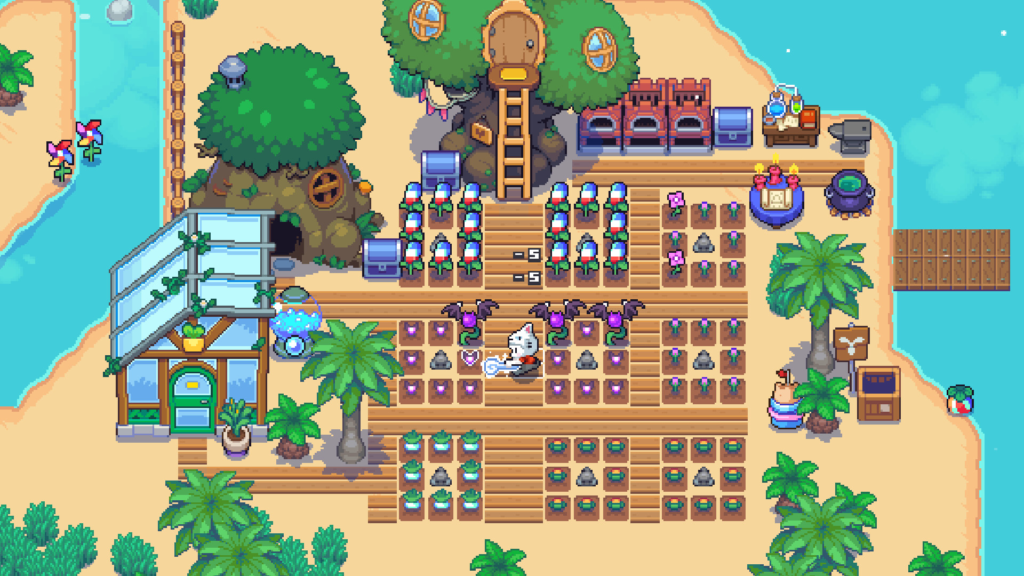
Tried-and-true farming mechanics weave nicely into other elements of gameplay.
Each plant also comes with attributes like increasing your HP or your Spirits’ defenses. This is one of the ways farming simulation influences various elements of Moonstone Island’s gameplay. By impacting you and your Spirits’ stats via either raw consumption or brewed potions, crops can strongly affect the efficiency of your combat and exploration. They can also be gifted to townsfolk to score relationship points.
Moonstone Island offers diverse, queer-friendly dating options and introduces a unique tactic for winning their favor.
Your character is designed to be gender-neutral with NPCs avoiding the use of pronouns when addressing you. There are various male, female, and non-binary singles for you to strike up a relationship with.
All of the singles are cute (in my opinion). But Ferra, the flirty and outgoing blacksmith, was my first pick when deciding who to go steady with.
A close second was the relaxed and friendly botanist, Ofelia. In addition to loving her personality and character design, I was thrilled when I realized she spoke Tagalog! The diverse cast of villagers spanning gender identities and cultures was a wonderful, much appreciated touch that I hope to see in more video games.
Your relationship status with villagers can be deduced from the amount of hearts that appear filled in when you speak with them. Filling in enough hearts opens up the option to become partners. This is typical of farming sims with such dating components, used in both Harvest Moon and Stardew Valley. However, Moonstone Island changes it up by putting more emphasis on dialogue options.

When you speak to NPCs, you will usually be able to see which dialogue options have the best chance of working based on the percentage values displayed next to them. You can chat, joke, and flirt with townsfolk, or you can invite them on dates to certain locations around Moonstone Island. When on a date, you will not be shown which dialogue options have the best chance of winning them over.
I enjoyed the cut scenes that occurred during dates and found them helpful when working to achieve maximum hearts with all characters. Because I found this component so cute and beneficial, I wish there were more than three location options to choose from, so I could experience more of it.

Moonstone Island’s fishing minigame is a simple but solid spin on this common farming sim component.
Like any good farming sim, Moonstone Island lets you kill time with fishing. The game is full of strange fantasy-fish that can be caught depending on the island type you’re fishing on.
I prefer when fishing is turned into a minigame, rather than just being a series of clicks where you drop the bait in the water and pull out your catch. Moonstone Island puts its spin on fishing by challenging you to hover your cursor over a fish who may or may not be swimming quickly and bouncing around. This minigame works well, being quick, simple and fun to replay.

Time budgeting is the biggest hurdle of the game.
The large map is scattered with various monster, plant, and terrain types. You can spend dozens of hours braving this vast pixel world with 100 different islands and over 60 creatures to fight and tame. There’s so much to accomplish that you’ll need to budget your time wisely in order to complete all your tasks before 2:00 AM when your character unceremoniously falls asleep wherever they’re standing.
Final Thoughts
Though I appreciate the diversity and sheer amount of content, I’d love if certain goals were just a bit more challenging to achieve. For example, making some Spirits weak to different types (or even specific attacks or potions) could make winning battles seem less linear and predictable.
Sure, I liked being able to just turn my brain on autopilot, basking in the pleasing pixel graphics and relaxing atmosphere. But I feel certain tweaks could make the game more engaging and memorable without sacrificing too much accessibility. Another example would be not giving away success rates (or having an option to disable success rates) for dialogue options when gathering villager heart points. Each villager already has such a unique character design and personality that it would be fun to have to use those cues to determine the best replies.
Moonstone Island does a great job blending different gameplay elements, providing a peaceful place where you can enjoy the usual delights of farming sims such as tending crops, fishing, and earning relationship points with townsfolk. However, it makes itself stand out with fun exploration, turn-based battle, and creature collecting components. Pick up Moonstone Island if you enjoy (or think you would enjoy) cozy farming sims with an RPG twist, like Stardew Valley or Run Factory, since they share similar vibes and core features.
